Method statement template
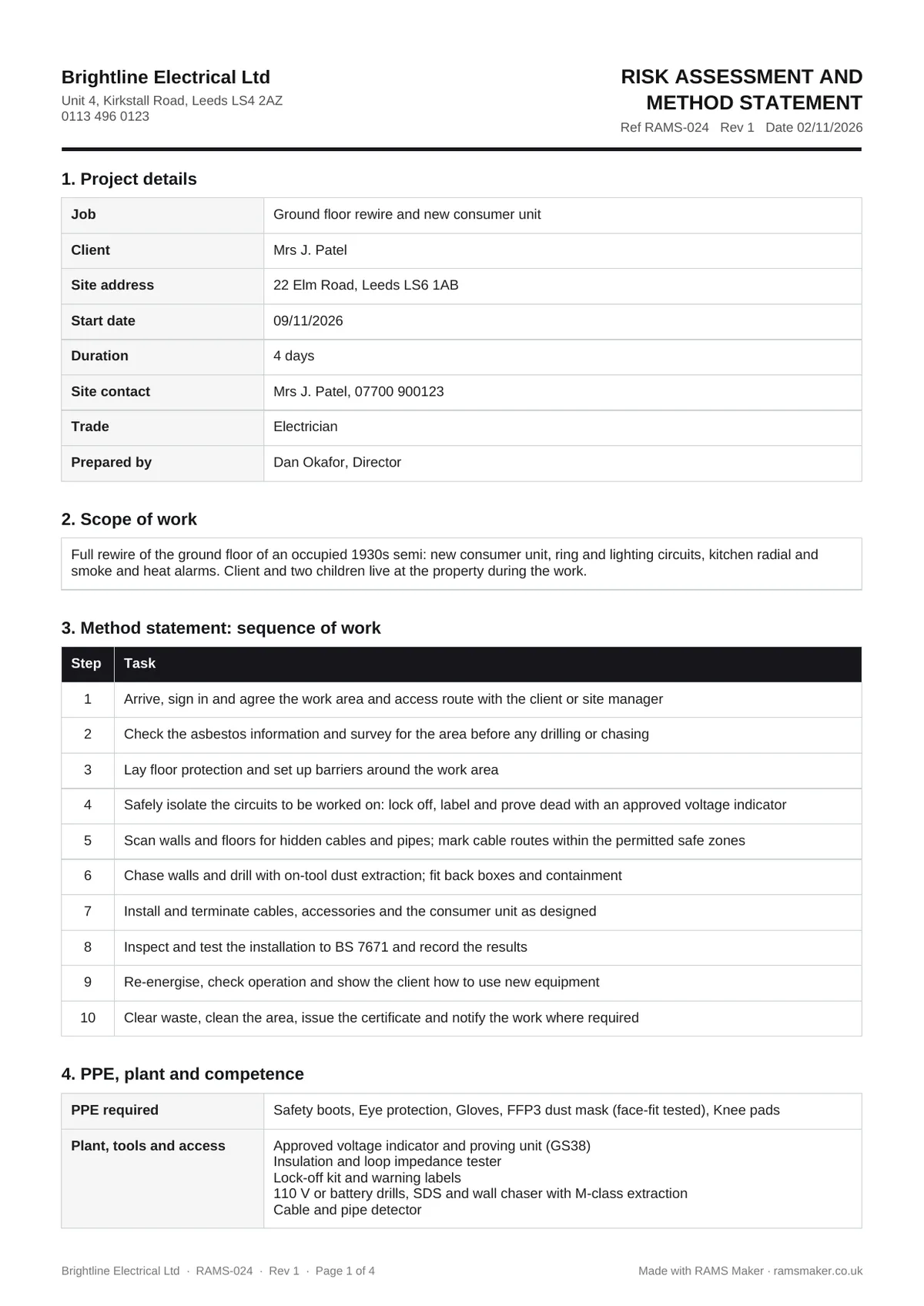
A method statement sets out, step by step, how a job will be done safely: the order of work, the equipment, the people and the precautions. It is usually paired with a risk assessment, which together make up RAMS.
Get the sequence of work written for you. Choose your trade and RAMS Maker drafts the method statement and the risk assessment; you edit it to fit the site.
Make a method statementWhat is a method statement?
It is the practical plan for the job. Where the risk assessment asks “what could hurt someone and how do we stop it?”, the method statement answers “how exactly will we do this job, in what order?”. It is written for the people doing the work, so it should be short, specific and in plain language.
Do you need one?
HSE says a method statement is a legal requirement for demolition, dismantling and structural alteration, where the arrangements must be recorded in writing before work begins. For other construction work it is not required by law, but it is standard practice, and most principal contractors, councils, housing associations and commercial clients will not let you start without one.
What to include
- Job and site details: what, where, when, for whom, and the document reference and revision.
- Scope: what is and is not included.
- Sequence of work: numbered steps from arrival to handover.
- People: who supervises, who does what, and their training (CSCS, PASMA, asbestos awareness, trade qualifications).
- Plant and equipment: tools, access equipment and how they are checked.
- PPE for each task.
- Permits and isolations: hot work, permit to dig, electrical isolation. Hot work in a building in use should also be covered by the premises’ fire risk assessment.
- Emergencies: first aid, nearest A&E, fire and spill procedures.
- Welfare: toilets, washing and rest facilities.
- Sign-off: who wrote it, who approved it, and who has been briefed.
Example: sequence of work for a consumer unit change
- Arrive, sign in, agree the work area and the power-off time with the client.
- Check the asbestos information for the area around the consumer unit.
- Isolate the supply, lock off, label and prove dead with an approved voltage indicator.
- Remove the old consumer unit; label circuits as they are disconnected.
- Fit and terminate the new consumer unit.
- Inspect and test to BS 7671 and record the results.
- Re-energise, check every circuit and show the client the new board.
- Clear waste, issue the certificate and notify the work.
Questions
What is the difference between a method statement and a risk assessment?
The risk assessment identifies hazards, who could be harmed and the controls. The method statement describes how the job will be done safely, step by step. Contractors normally provide both together as RAMS.
How long should a method statement be?
As short as it can be while still being specific to the job. One or two pages for a small job is normal; long generic documents tend not to be read.
Can I use the same method statement for every job?
You can reuse your own as a starting point, but update the site details, the sequence and the hazards for each job, and brief the team again.
Related: RAMS template · Toolbox talks · Construction phase plan
Legal points checked against hse.gov.uk on 31 October 2026.